Paint It and Let It Go: What Water Calligraphy Taught Me About Boldness
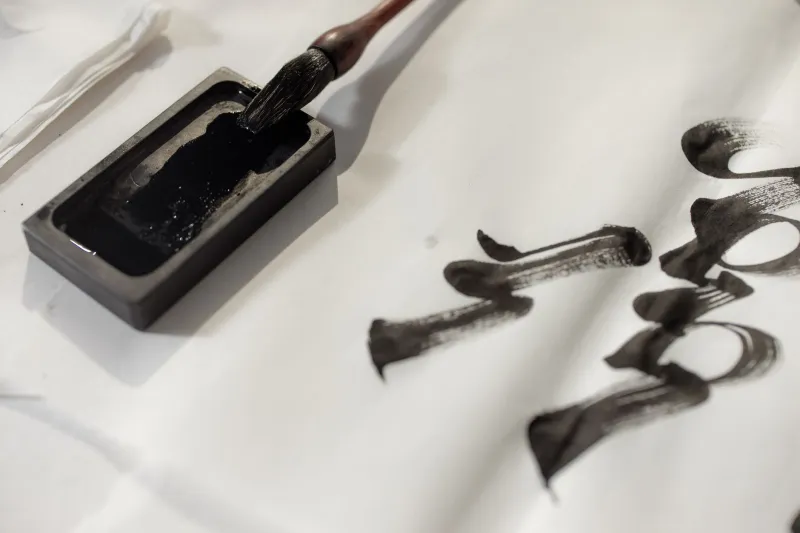
There's a video that circulates every summer: an elderly man in a Beijing park dragging a sponge-tipped water brush across hot pavement, laying down enormous, confident characters that evaporate behind him as he writes. By the time he finishes a line, the beginning is already gone. He never looks back. He never fixes anything.
The first time I saw it, I felt a small panic in my chest. Where's the finished piece? Then I watched longer and realized I'd been asking the wrong question. The finished piece was the writing of it.
This is the strange gift of ephemeral art — work made knowing it won't survive the day, the rain, or the hour. And I've come to believe every artist, especially those of us who freeze up in front of expensive paper, should try it at least once.
The Monks Who Sweep Away Masterpieces
If you've visited a museum with a Tibetan art collection, you may have seen a sand mandala — not because it survived, but because monks spent days or weeks placing millions of grains of colored sand into impossibly intricate patterns, then deliberately swept it all up in a closing ceremony. The sand is often poured into running water.
The tradition behind it, mudra of impermanence, isn't about loss. It's about holding the work loosely. The monks aren't careless; they're meticulous. The dissolution isn't a tragedy tacked onto the end — it's part of the piece.
Japanese aesthetics has its own vocabulary for this. Mono no aware — the gentle ache of transience — runs through everything from cherry blossom viewing to the way a tea bowl is chosen for its slight imperfection. Nothing is treasured despite being temporary. It's treasured partly because of it.
Western art culture, especially here in the US, pushes the opposite instinct. We archive. We scan. We laminate the good sketches. We treat every drawing like it might be the one, so every drawing carries the weight of being the one. That weight is exactly what kills boldness.
Why Erasable Mediums Make Bolder Marks
Here's what happened when I tried water calligraphy myself, on my driveway one Saturday in July: I wrote bigger than I have in years.
There was no hesitation at the start of a stroke, because there was nothing to ruin. No internal editor whispering that line's crooked, start over. The medium's whole deal is that it disappears, so perfectionism had nothing to grip onto. My arm just moved.
This isn't a mystical observation — it's pretty basic psychology. When the stakes of a single mark drop to zero, the fear that stiffens your wrist drops with it. And here's the kicker: the muscle memory of that loose, committed stroke doesn't vanish when the water does. It comes inside with you.
Artists have known this informally forever. Gesture drawing works partly because the pose only lasts thirty seconds. Charcoal landscape sketching on location feels freer than studio oil painting partly because charcoal is so negotiable. Ephemeral work just takes the principle to its logical extreme.
Your Weekend Challenge: Make Something That Won't Last a Day
You don't need a monastery or even a park. Here's a simple challenge you can do this weekend, borrowed and adapted from a few traditions:
Saturday morning: pavement calligraphy. Get a bucket of water and the largest brush you own — a two-inch hardware store paintbrush works fine, or a mop if you're feeling dramatic. On a warm day, write or paint on a concrete driveway, sidewalk, or patio. Write a single word. Write it again, bigger. Write it until the first one has evaporated. Twenty minutes is plenty.
Saturday afternoon: the frost or fog window. If it's winter where you are, breathe on a window and draw in the condensation with your fingertip. If it's summer, trace shapes on a steamed-up bathroom mirror or draw in spilled flour on the counter. Same rules: no fixing, no photographing for the grid, no saving.
Sunday: the arrangement. Gather natural objects — leaves, pebbles, flower petals, whatever your yard or a walk provides — and arrange them into a composition on the ground or a table. Sit with it. Then, before dinner, take it apart and put everything back where it came from.
That last step is the hard one, and it's the whole point. You will feel a genuine twinge. Notice it. That twinge is your attachment showing, and seeing it clearly is more instructive than another hundred permanent sketches.
Bringing the Disappearing Ink Back to Permanent Work
So how does any of this transfer to work you actually keep? Three things stuck with me after the weekend:
Commitment per stroke goes up. When you've practiced making marks that can't be corrected, you stop making tentative, halfway marks on paper that can. My ink brushwork on Monday was noticeably more decisive.
The process becomes the product. Knowing a piece will vanish redirects your attention from the outcome to the doing — which, honestly, is where most of the joy of this craft lives anyway. That attention is portable. You can bring it to a commission, a comic page, a wedding invitation.
You get pickier about what deserves permanence. After making a dozen throwaway pieces, I looked at my sketchbook differently. Not everything needs to be saved, scanned, and archived. Some pages exist so the next page can be good. Letting a weak drawing simply be a weak drawing — rather than a failed artifact — is oddly freeing.
There's a line I think about from the tea ceremony tradition: ichi-go ichi-e, often translated as "one time, one meeting" — the idea that this gathering, this moment, will never occur again, so it deserves your full presence.
The man in the park isn't making nothing. He's making the moment, once, with total commitment, and letting it go. Turns out you can practice that with a bucket and a paintbrush on a Saturday morning. And Monday's work is better for it.