The Kintsugi Sketchbook: What Your Mistakes Are Trying to Tell You
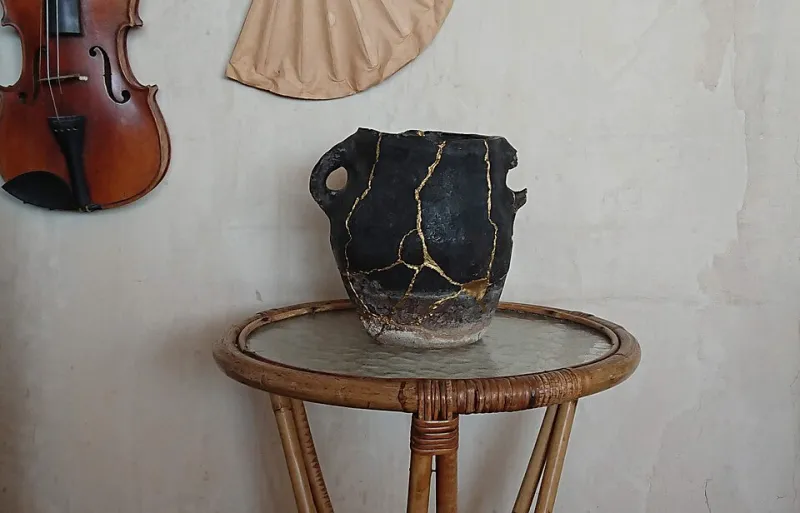
Photo: Guggger, CC BY-SA 4.0, via Wikimedia Commons
There's a drawer in almost every artist's studio — physical or digital — full of work that never saw the light of day. The portrait where the eyes didn't match. The landscape abandoned at the halfway mark. The illustration scrapped because a line wobbled when you wanted it to glide.
In Japan, there's a word for the kind of beauty those rejected pieces might contain: wabi-sabi. And if you've never let it into your creative practice, you might be throwing away your best work before it has a chance to become anything at all.
What Wabi-Sabi Actually Means (Beyond the Pinterest Version)
Wabi-sabi gets reduced a lot in Western design blogs to 'rustic' or 'imperfect on purpose.' That's selling it short. Wabi (侘び) originally carried a sense of loneliness or quiet simplicity, while sabi (寂び) speaks to the patina of age — the weathered look of something that has lived. Together, they describe an aesthetic that finds value in things precisely because they are imperfect, impermanent, and incomplete.
The classic image is kintsugi — repairing broken pottery with gold lacquer so the crack becomes the most beautiful part of the object. But you don't need gold leaf to practice this. You need a shift in how you judge your own marks on the page.
Think about what happens in a typical American art education. Critique culture. Portfolio reviews. 'Tighten that up.' 'Clean your lines.' The message, repeated for years, is that flaws are failures to be engineered out. Wabi-sabi flips the equation: the wobble is evidence of a human hand, and a human hand is the whole point.
The Perfectionism Tax
Ask any working illustrator in the US and they'll tell you the same thing: the pursuit of polish eats time, energy, and sometimes the joy that got them into art in the first place. Redrawing a line twelve times until it matches the one in your head isn't craftsmanship — it's often just fear wearing a professional costume.
There's a practical cost, too. Artists who polish endlessly post less, experiment less, and burn out more. Meanwhile, some of the most beloved illustration work coming out right now — think of the loose, gestural character designs that dominate indie games and animated shorts, or picture books whose crayon-textured linework feels like it was drawn by a kid who never learned to be ashamed of a scribble — succeeds because it refuses to be smooth.
Artists like Carson Ellis, whose picture-book illustrations keep a hand-drawn roughness that a lesser artist would have sanded away, or the sketchbook-first approach of illustrators who publish their process work as finished products, prove something important: the audience can feel the difference between a drawing and a rendering. One has a pulse. The other has a finish.
Three Exercises for the Flawed-Work Skeptic
If you're ready to experiment, try these. Fair warning: they will feel uncomfortable. That discomfort is the perfectionism leaving.
1. The One-Line Rule. Draw a subject using a single unbroken line, never lifting your pen. You cannot erase, and you cannot 'fix' the path once it's started. The resulting drawing will be lopsided and strange — and often more alive than your careful version. Do this daily for a week.
2. Finish by Not Finishing. Take an old abandoned piece — that drawer full of near-misses — and declare it finished exactly as it is. Crop it, sign it, post it. Incomplete edges and unresolved areas are allowed to stay. Notice how much of your urge to 'complete' it was habit rather than vision.
3. The Kintsugi Pass. Next time you make a genuine mistake — a spilled ink blot, a smeared wash, a line that jumped the tracks — don't cover it. Emphasize it. Trace it in a brighter color, build the composition around it, make the accident the focal point. This is kintsugi thinking applied directly to two dimensions.
Impermanence Is Part of the Craft
There's one more piece of wabi-sabi worth sitting with: nothing you make is permanent, and neither is your skill level. The drawing you hate today is a snapshot of where you were. The 'flaws' you see in last year's work aren't embarrassments — they're growth rings.
American creative culture tends to frame everything as a climb: better skills, bigger portfolio, more polish. Wabi-sabi suggests a different relationship with time. Your sketchbook is a record of a person changing, and a person changing is never going to look symmetrical.
So the next time a line goes sideways and your hand reaches for the undo key, pause. Ask what the flaw is doing there. Sometimes the answer is: nothing good, fix it. But sometimes — more often than perfectionism wants you to believe — it's the most interesting thing on the page.
Keep the gold pen handy.