One Eye Open: Painting a Daruma for the Goal You’ll Actually Finish
Every studio shelf needs one object that is not there to look pretty. Mine is a papier-mâché daruma with one eye painted in and one eye staring back as a blank white circle. It is not subtle. It is not decorative in the usual sense. It is, however, the most effective goal-tracking tool I have ever put on a desk.
The daruma is a Japanese good-luck figure modeled after Bodhidharma, the legendary Zen monk. Traditional versions are round, weighted at the bottom, and designed to pop back upright when tipped over. That wobble is the whole metaphor: fall down, get up. The eyes are left blank when you buy one. You fill in one eye when you commit to a goal, and the other when the goal is done. No app notifications. No color-coded spreadsheet. Just a small red face reminding you that you said you would do a thing.
This is a hands-on guide to painting your own daruma for your studio shelf — and to using it as a one-goal ritual rather than another craft project you abandon by February.
Why a Daruma Beats a Long Resolution List
Most creative goal lists are fiction. They are wish lists wearing a productivity costume. Learn anatomy. Post three times a week. Finally understand perspective. Make a zine. The list gets longer, the guilt gets heavier, and nothing gets the focused attention it deserves.
A daruma forces a different question: what is the one thing you want to finish?
Not ten things. One. A single illustration portfolio piece. A sketchbook you actually fill. A small comic. A print series. Something you can describe in one sentence without using the word “eventually.” The figure sits on your shelf with one eye open, and every time you sit down to work, it asks whether today’s effort is moving toward that goal or just rearranging the clutter around it.
That is the advantage of a visible object over a forgotten note. It does not nag. It just watches.
A Very Short Daruma History, Because Context Helps
Daruma figures are associated with Takasaki, a city in Gunma Prefecture, Japan, where they have been made for centuries. The form comes from Bodhidharma, the semi-legendary founder of Zen Buddhism, who is often depicted as a bearded, wide-eyed monk. The round shape and weighted base are practical folk-art touches, but they also carry the idea of resilience: knock it down, and it returns upright.
Traditional daruma are usually red, a color associated with protection and good fortune. Many have gold accents, a bushy beard, and eyebrows shaped like cranes, with a mustache sometimes resembling a turtle. Cranes and turtles are both symbols of longevity. You do not need to reproduce every traditional detail to make a meaningful one. You just need to understand what you are borrowing.
What You Need for a Studio Daruma
You can buy a blank papier-mâché daruma at many craft stores or online. If you already have a finished daruma with blank eyes, you can skip the body painting and go straight to the ritual. For a fully painted version, gather:
- A blank daruma figure
- Acrylic paint in red, white, black, and gold
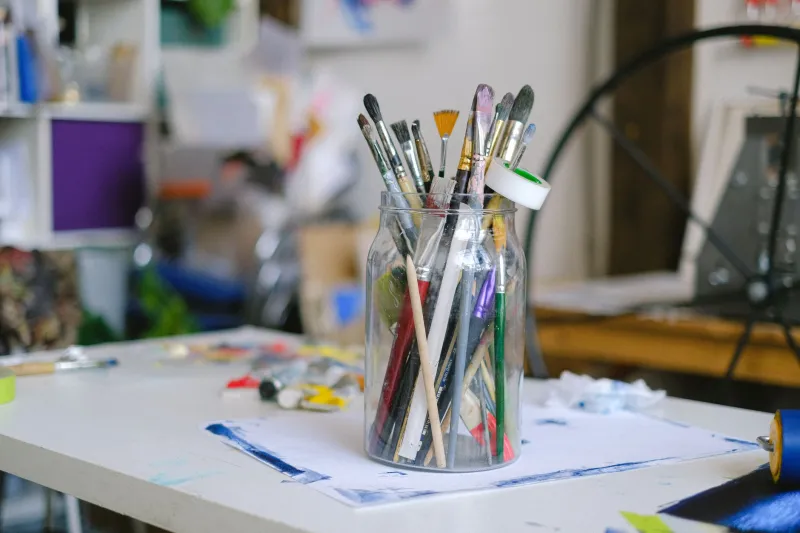
- A small flat brush and a fine detail brush
- A pencil for light guidelines
- A cup of water and a paper towel
- Optional: a matte varnish
Keep the palette simple. The charm of a daruma is in the face, not in a busy background. A bright red body, a white face area, black features, and a little gold goes a long way.
Paint the Body First, Then Stop Thinking
Give the figure a base coat of red and let it dry completely. Papier-mâché can soak up paint, so two thin coats usually look better than one thick one. Thin coats also preserve the texture of the surface, which is part of the handmade appeal.
Once the red is dry, block in the face area with white. Traditional daruma have a white oval or rounded rectangle where the features sit. Sketch it lightly in pencil first. If it is slightly crooked, decide now whether you care. A perfectly symmetrical daruma can look stiff. A little asymmetry gives it personality.
Let the white dry before adding features. Acrylic paint is forgiving, but it is not forgiving enough to fix black lines dragged through wet white.
The Face Is the Whole Personality
Start with the eyebrows. Traditional daruma eyebrows are often shaped like cranes, but for your first one, simple thick arcs are fine. Add the mustache and beard with the fine brush. The beard is usually a solid dark shape with a few white or gold highlights, not a hundred individual hairs. Keep it graphic.
The eyes are the important part. Leave them blank for now. You can outline them lightly, but do not fill them until the ritual. If you want a traditional touch, paint a small crane shape into each eyebrow or add a tiny gold accent on the chest. Gold paint is not required, but it does make the figure look less like a painted potato.
Let everything dry, then seal with matte varnish if you want it to survive studio life. A daruma on a shelf will collect dust, pencil shavings, and the occasional splash of coffee. A little protection helps.
The Eye Ritual: One Goal, Not Twelve
Here is where the craft project becomes a practice. Decide on one goal for 2026. Write it down somewhere private first, because a daruma is not a billboard. Then pick a convention: many people fill the left eye first and the right eye when the goal is complete. Others do the opposite. Choose one and stick with it.
Use black paint and a fine brush. Fill the first eye carefully. This is not a dramatic ceremony. It is a small, deliberate action that says: I am committing to this. The figure now has one eye open. It looks slightly unfinished, because it is. That is the point.
Put the daruma where you actually work. Not on a high shelf where it becomes decoration. On the desk, near your sketchbook or monitor. Let it be the first thing you see when you sit down and the last thing you see when you quit for the day.
Living With a Half-Finished Face
A one-eyed daruma is a strange little roommate. It does not congratulate you. It does not offer productivity tips. It just sits there with one open eye and one blank one, representing the gap between intention and completion.
That gap is useful. Most creative goals die in the gap. We start strong, then get distracted by a new idea, a new supply, a new project that feels easier because it has no history. The daruma does not prevent that. But it makes the abandonment visible. You have to look at it.
I keep mine next to a small stack of reference books and a jar of pencils. When I am avoiding the actual work, I notice the blank eye. When I am making progress, I notice it too. The figure does not care either way. It is just a painted object. But objects can hold agreements.
When the Second Eye Goes In
Finish the goal, then fill the second eye. Do it on a day when you can actually pause. The completion does not have to be perfect. The sketchbook can be messy. The portfolio piece can have flaws. The point is that you closed the loop.
After both eyes are painted, the daruma becomes a record. You can keep it on the shelf as a finished object, or you can start a new one for the next goal. Some people burn or discard the old figure; others keep them in a row like small red trophies. There is no single correct rule. The ritual belongs to you.
What matters is the simplicity of the system. One figure. Two eyes. One goal at a time. In a studio full of half-started projects, that is a surprisingly rare kind of clarity.