The Soft Edge Method: A Chigiri-e Still Life for People Who Hate Drawing
Photo: torn washi paper collage still life art supplies handmade paper, via kelvinskitchen.com
Most blank-page fear comes from the same place: the belief that the first mark has to be correct. Pencil lines feel permanent even when they are not. Erasers leave ghosts. And somewhere between the empty sheet and the finished picture, the whole thing can seize up.
Chigiri-e sidesteps that trap. It is a Japanese collage tradition built on torn paper rather than cut paper, and its basic move is almost embarrassingly simple: choose a color, tear a shape, glue it down. No perspective grid. No anatomy. No drawing at all, unless you want one. The paper does the heavy lifting, and the ragged edge does something a scissor blade cannot. It softens the boundary between one shape and the next, the way a wet brush softens watercolor.
If you have been circling art-making from a safe distance, this is a good place to land.
What the Medium Actually Asks
Chigiri-e does not ask for accuracy. It asks for patience with your own hands. Torn paper has a mind of its own; the fibers separate along a slightly different path every time. That is the point. In Japanese paper work, the irregular edge is often the most expressive part. A little feathered, a little uncertain, alive.
You will need paper, glue, and a surface. That is it. No expensive brushes. No drawing tablet. No good-enough threshold to clear before you begin.
Make a Small Palette of Hand-Painted Papers
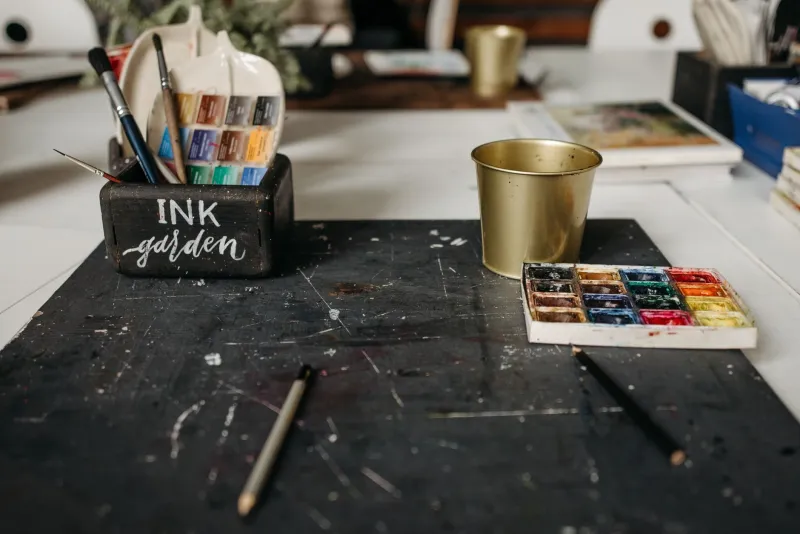
Real washi is lovely, but you do not need a specialty store to start. Lightweight watercolor paper, deli paper, tissue paper, and plain copy paper all take paint differently and tear differently, which is useful. Paint a few sheets with diluted acrylic or watercolor in the colors of your subject. Let them dry completely. You are aiming for variation, not flat color: a few streaks, a few pale patches, a few darker edges.
If mixing paint sounds like too much, raid the scrap drawer. Old maps, painted junk mail, tissue from shoe boxes, and security envelopes all work. The only rule is that the paper should be thin enough to tear comfortably and matte enough to accept glue.
Choose Three Shapes, Not a Scene
A persimmon, a teacup, a folded cloth. A pear, a small bowl, a single leaf. Three shapes is enough for a first piece, and a 6-by-8-inch panel is enough space. Pick objects with clear silhouettes and one strong color note. You are not making a botanical study. You are making a paper poem about a few things on a table.
Place them in front of you. Snap a phone photo for reference if you like, but do not over-plan. The composition can be decided in paper.
Tear First, Arrange Second
Tearing is a skill, but not a difficult one. Hold the paper between both thumbs and forefingers, close to your body, and tear slowly toward yourself. The edge will feather. For a softer, more controlled tear, dampen a line with a barely wet brush and wait a few seconds before pulling. For a rougher edge, tear dry and fast. Both are valid.
Do not use scissors. This is not a moral rule; it is a practical one. Cut edges look graphic and hard. Torn edges look like weather. They let colors bleed into one another visually, even when the paper is opaque.
Build Back to Front
Start with the background: a loose field of color, maybe two torn pieces overlapping. Then the shadow shapes. Then the objects themselves. Then the smallest highlights. A glue stick is fine for a quick study; diluted white glue or Mod Podge gives you a little more working time. Brush glue onto the paper, not the board, and press each piece down with a clean finger or a scrap of wax paper.
Resist the urge to trim. If a piece hangs over the edge, tear it smaller rather than cutting it. If a shape looks wrong, lift it while the glue is still wet and try again. Chigiri-e is forgiving in a way that ink is not.
Let Imperfection Be the Style
The finished piece will have gaps. Fibers will stick up. A color will be slightly off. Leave it. The soft, slightly blurred edge is the signature of the medium. When you stop trying to make torn paper behave like a crisp illustration, the work gets better. Looser, more atmospheric, more like a memory of the object than a report on it.
Let it dry flat. Sign the back if you want. Then make another one with the scraps. The second piece is usually where the fear falls away.