Send Something Slightly Crooked: A Beginner's Etegami Practice for the 2026 Card Season
Every December I go through the same small crisis. I have a drawer of nice cards, a list of people I genuinely like, and about forty minutes of patience. Store-bought cards solve the logistics and none of the warmth, and I always feel a little hollow signing my name under someone else's artwork.
Then a friend sent me something that changed the whole ritual. It was a postcard-sized watercolor of a single persimmon — lopsided, bleeding slightly at one edge — with three handwritten lines on it. No printed greeting. No gold foil. Just fruit and handwriting. It looked like it had been made in eleven minutes, and it was the best piece of mail I got that year.
That's etegami, and it might be the most forgiving art form you can pick up before the holidays.
What Etegami Actually Is
Etegami translates roughly to "picture letter." It's a Japanese folk tradition: a small image, done quickly in sumi ink and watercolor or gouache, plus a few words of your own handwriting. The whole thing fits on a postcard. The tradition is associated with the New Year's card boom in Japan — nengajo season, when millions of these get mailed out — but the format works for any occasion, or none.
The part that trips up Western beginners is that etegami is not supposed to be technically good. It's supposed to be alive. The classic teaching is that a good etegami has warmth, and warmth comes from imperfection: uneven lines, a color that pooled where you didn't plan, a brush that ran out of ink halfway through a stem. There's a well-known idea in the practice that the maker should avoid fussing. You paint the thing, you write the words, you stop.
If you've spent years trying to make art that looks authoritative, this is going to feel strange for about twenty minutes. Then it's going to feel like taking off a tight shoe.
The Setup Is Almost Insultingly Cheap
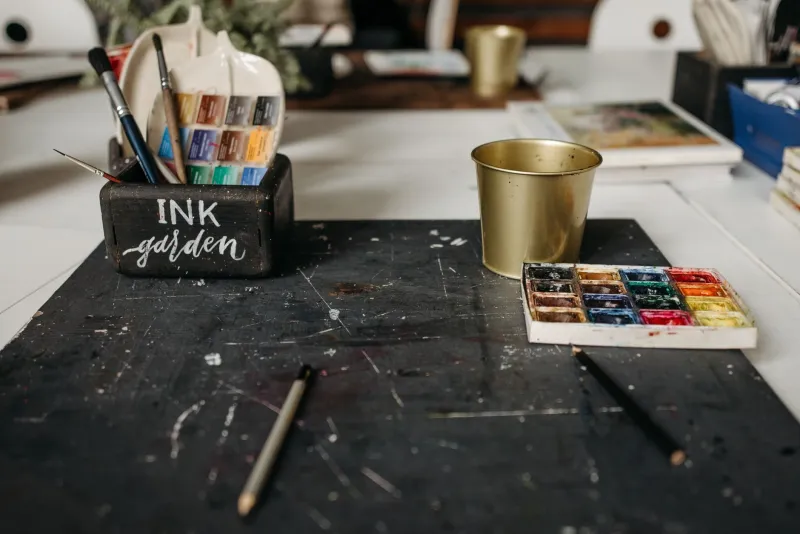
Here's the entire supply list for your first batch:
- A brush. One small-to-medium soft brush for color, one smaller one for ink. A single watercolor brush will honestly do.
- Sumi ink. A bottle of liquid sumi (or a decent india ink if you can't find sumi locally — though sumi has a warmer black and a wonderful way of going gray as it runs dry).
- Watercolor or gouache. A basic set. You need maybe six colors.
- Paper. Blank postcards, or watercolor paper cut to 4 x 6 inches. Heavier is better so your card survives the mail.
- A pen or brush for the words. Many etegami artists write with a fountain pen or a fine brush.
That's it. No rulers, no grid, no light box. And genuinely — no eraser. You can't erase ink, and that's the point.
Pick One Subject and Stay With It
New etegami people always want to make five different images for five different people. Don't. Pick one subject and repeat it across your whole card list. You'll get better by card four, and your friends get to be part of a small series, which is its own kind of gift.
Good subjects are things that sit still and have a strong silhouette:
- A persimmon. Arguably the perfect etegami subject. Orange, round, a little leaf on top, and it's everywhere in late-autumn Japanese art for a reason.
- A pine branch. Three or four needle clusters, one confident dark stroke for the stem.
- Your favorite mug. The one you actually drink from every morning. This one is underrated — it turns a card into a tiny portrait of your daily life.
- A single citrus fruit, a radish, a sprig of holly, a chipped teacup. Anything with an edge.
One object per card. Resist the urge to build a scene.
Painting Loose, on Purpose
Load your brush, touch it to paper, and move. The single biggest beginner mistake is going back in to fix a shape. Watch what happens when you don't.
Paint the shape once. One persimmon body, one pass. If the edge wobbles, that's the drawing now.
Let the ink run out. Draw your pine stem and keep going after the brush is nearly dry. The fading, scratchy tail is one of the most beautiful things in etegami and you cannot fake it convincingly.
Leave white paper. Don't fill the card. A small image in the upper left with a lot of empty space feels composed and calm; a small image surrounded by doodles feels nervous.
Skip the outline. Resist putting a black line around your mug. Let the color hold the form. If it collapses, that's information — next time use more pigment.
Stop while it's still slightly wrong. This is the hard one. The card that looks 80 percent finished usually looks better than the one you took back to the table three times.
Dry everything flat. Watercolor on postcard stock will curl as it dries, and you can press cards under a heavy book overnight — a stack of hardcovers and a cutting board work fine.
The Words Matter More Than You Think
Etegami isn't a painting with a signature. The writing is half the form, and it's usually handwritten vertically down one side or in a short block below the image.
A few things that help:
- Write it in one go. Pick your sentence before you dip the pen. Don't draft it on the card in pencil — the graphite will show and it kills the spontaneity.
- Keep it short. Two or three lines. A specific memory, a wish, a joke, a thank-you for something small.
- Let it be uneven. Your handwriting will change when you slow down. That's fine.
- Use their name. A card addressed to a person beats a card addressed to "Friend."
If you want a Japanese touch without faking fluency, a single well-chosen seasonal word is a nice move — but write it in English unless the recipient reads Japanese. Nobody's grandmother is impressed by a machine-translated phrase.
The Mailing Ritual
Set aside one evening. Spread the finished cards out, don't touch them, and look at the whole batch together. You'll notice the fourth one is looser than the first. Keep them anyway; the batch should show the learning.
Address them by hand. Real stamps, not the printed postage meter, if you can manage it. Tuck nothing else in the envelope — no business card, no photo, no newsletter. The card is the whole message.
Mail them between now and the second week of December if you want them to land before the holidays. New Year's cards traditionally arrive on the first of January, but American mail being American mail, give it a week of cushion.
Your Challenge: Five Cards, No Store-Bought Backup
Here's the thing I'd actually ask you to do this season. Not fifty cards. Not a hand-painted card for every person you've ever met. Five.
Pick five people. Pick one subject — persimmon, pine branch, your morning mug. Make five cards in one sitting, badly on purpose. Write two honest lines on each. Mail them.
The first one will look like a watercolor accident. The fifth will look like something someone would keep in a drawer for years. And somewhere in the middle, you'll notice you stopped caring whether the lines were straight — which is roughly the entire philosophy of etegami, and a pretty good way to end a year.